
The Stakeholder-Centered Coaching Model
Our methodology begins with a simple truth: leaders often cannot see what they cannot see. We solve this by making the feedback loop visible and actionable.
Seven Steps to Lasting Change
The model integrates direct feedback from the people who work closest to the leader: direct reports, peers, and leaders. This creates accountability that self-reflection alone cannot produce.
Rather than asking a leader, “What do you need to change?” we ask their stakeholders: “What would make this leader more effective?” When leaders hear feedback from people they respect and work with daily, the motivation to change becomes intrinsic, not imposed.
The circular model is not theoretical. It is the architecture of the engagement. Each step builds on the previous one, creating momentum toward sustainable behavioral change.
The process emphasizes feedforward rather than feedback: focusing on what can be improved going forward instead of dwelling on past missteps.
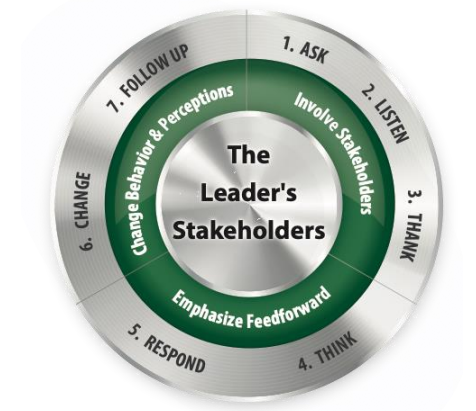
The Seven Steps in Action
1. Ask
Gather structured feedback from key stakeholders
2. Listen
Receive feedback from peers without defensiveness
3. Think
Reflect on patterns in the feedback with a coach
4. Respond
Commit to specific behavioral changes
5. Change
Practice new behaviors in real situations
6. Emphasize Feedforward
Share progress and gather forward-focused input
7. Follow Up
Reinforce momentum with continued accountability
See It in Action
In this brief video, Joseph walks through how Stakeholder-Centered Coaching creates the conditions for real change, and why leaders find it so different from traditional coaching experiences.
Ready to see a change in your own business?
Get in touch todayReady to see a change in your own business?
Why Stakeholder-Centered Coaching Works
This methodology is grounded in research and tested across hundreds of leaders. Here are the five core reasons why it produces measurable, lasting change.
Feedback Bypasses Self-Perception Bias
Leaders often have a dramatically different view of their impact than their stakeholders do. Grounding feedback in peer and direct report observations moves past rationalization and creates genuine motivation for change.
Public Commitment Drives Accountability
When a leader commits to behavioral change in front of the people who will observe that change, accountability shifts. Stakeholders become observers and reinforcers of new behaviors.
Small Behavioral Shifts Produce Visible Results
The work focuses on one or two behaviors with the highest leadership impact. When listening, delegation, or clarity improves, teams notice within weeks and momentum builds.
Regular Feedback Loops Create Course Correction
Regular touchpoints surface progress and drift quickly. That lets the leader correct in real time instead of waiting until the engagement is almost over.
Change Impacts Team Performance and Morale
When a leader genuinely changes how they lead, the team feels it. Psychological safety, decision-making, retention, and business results can all improve.
From Behavioral Change to Financial Accountability
The power of Stakeholder-Centered Coaching is that it translates directly into business results. Leadership change is measurable, and it impacts your bottom line.
Retention & Talent Cost
When leadership improves, retention improves. Replacing a strong leader or manager costs 1.5-2x their salary, so reducing unwanted attrition can create meaningful annual savings.
Decision Quality & Speed
Leaders who listen better make better decisions faster. They gather input, reduce rework, improve buy-in, and accelerate execution.
Productivity & Engagement
Clarity of purpose, psychological safety, and trust in leadership drive engagement. Better engagement often shows up as stronger discretionary effort and output.
Scalability & Succession
Leaders who delegate effectively become multipliers rather than bottlenecks. That is the difference between a business dependent on one person and one that can outlast its founder.
Leadership Pipeline
Improved leaders develop better leaders. Over time, this creates a leadership bench that turns succession planning from emergency work into a strategic advantage.
Client Impact & Growth
When leadership clarifies strategy and communicates vision, teams execute with better alignment. Clients notice the difference in responsiveness and strategic thinking.
The investment in Stakeholder-Centered Coaching typically pays for itself through improved retention alone. Everything else, including faster execution, better decisions, and deeper team engagement, becomes upside.
How We Deliver Stakeholder-Centered Coaching
Our approach is structured, time-bound, and designed to create momentum. Here is what a typical engagement looks like.
Initial Assessment
Feedback Synthesis
Goal Setting
Coaching & Practice
Mid-Point Check-In
Reinforcement & Integration
Final Feedback & Continuity
Ready to Understand How Your Leadership Is Perceived?
Stakeholder-Centered Coaching begins with clarity. We will conduct a brief assessment with you and 5-7 key stakeholders to understand what is working, what is holding you back, and where the highest leverage for change exists. You will walk away with clarity, whether you choose to work with us or not.